On the Edge of Darkness
The rain battered the windshield like a desperate child pleading for attention as I navigated the slick roads towards my granddaughter’s home. My hands gripped the steering wheel, knuckles white, heart pounding. At 1:58 a.m., a single phone call shattered any possibility of sleep. “Grandpa Harlan?” Sadie’s voice trembled through the phone, each word punctuated by shallow breaths, burning with fever. “I feel so hot. The room spins when I close my eyes.”
“Where are your mom and dad?” I asked, dread gnawing at my insides. The silence stretched, dense and suffocating. “They took Carter to Florida for his birthday,” she finally whispered, her voice tiny, broken. “Mom said I make sick days into a problem.”
Tears burned in my eyes. This wasn’t the first time I had heard her mother’s dismissive tone regarding Sadie’s health. “Please don’t tell Mom I bothered you,” she pleaded, each word a struggle against the throbbing discomfort that consumed her.
I encouraged her to sip water, coaxing her like a timid deer. “What do you see, sweet girl?” My eyes stayed on the road, wipers working furiously against the downpour.
“It’s a yellow blanket. It’s got moons on it… looks like space,” she murmured, her voice softer now, pulling my heart into a tight fist. I could picture her, small and vulnerable, curled up on the floor, trapped in discomfort and isolation.
By the time I arrived, the rain had transformed the street into a murky river, reflecting the dim light of the porch bulb. The door creaked open, a grim omen. I stepped inside, and the faint scents of antiseptic mixed with the musty air of an empty home hit me hard. Medicine littered the counter alongside a digital thermometer, its screen indicating 103.7 degrees—far too high for a child. The crackers lay untouched, and there it was: the note, coldly scrawled in a hurried hand: “Sadie, take a dose before bed. Do not turn this into a scene. Carter deserves his birthday.”
The anger erupted inside me, a cauldron of emotions boiling over. Here was the tangible evidence of their neglect, but what lay beneath was far more sinister. A flicker of movement on the floor caught my eye. Sadie lay there, twisted among the shadows, wrapped in her yellow moon blanket. I dropped to my knees beside her, feeling the warmth radiate from her small frame.
Her phone lay just beyond reach, a pile of missed calls from the very people who abandoned her. “I…I called them,” she rasped, her lips cracked, the corners of her mouth dry. Swollen eyes glimmered with unshed tears. “But they didn’t pick up.”
“Hold on a minute,” I said, my voice steady but my heart hammering. With shaking fingers, I dialed 911 while watching the weak rise and fall of her chest. The operator’s calm voice gave me structure amid my chaos.
“Please, I need an ambulance. My granddaughter is really sick—fever’s over 103. She’s been left home alone.”
After hanging up, I pulled out my phone and captured images of the note, the thermometer, the sad landscape of Sadie’s forgotten safety. The images would be my anchor against any lies they told. As if sensing my turmoil, Sadie’s hand reached out, trembling.
“Grandpa?”
“Yeah, Sadie, I’m right here.”
“Are they really gonna help?”
“Yes, sweetheart, they will.”
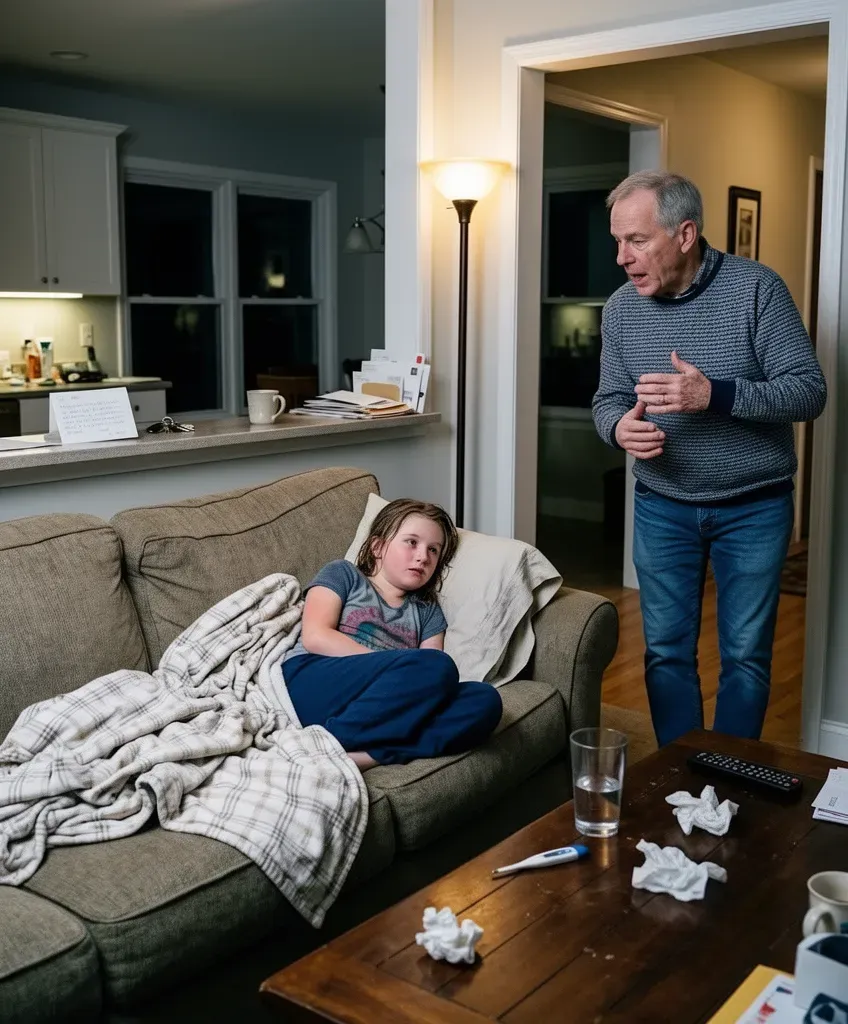
Moments passed like hours, and suddenly the door burst open. Wesley’s shadow loomed, a towering figure of indifference. “Why are you in my house?” he demanded, eyes narrowing on me, his voice dripping with disdain.
“Your daughter is gravely ill,” I shot back, the words thick with the weight of fury. “How could you leave her like this?”
Maren followed closely behind, her demeanor too cool for comfort. “She tends to get dramatic when Carter’s getting attention,” she said, waving a dismissive hand. “Just give her some medicine and put her to bed.” Each word struck like a slap across my face.
“That’s not good enough! Did you know she was so sick?” My voice rose, fueled by indignation and desperation. The paramedic stepped forward, a weight of authority in the chaos, keeping the peace.
The air grew thick with tension, anger simmering beneath the cracked surface of family ties. “Let’s not drag neighbors into this. Until it’s a real emergency,” Maren insisted, her voice biting.
**But the thermometer shifted the narrative entirely**. The number on that thermometer was no longer about a scene; it was a flashing defense against negligence. The paramedic promptly took it from my shaking hand, staring in disbelief.
“Maren,” he said, concern dripping from his voice, “this is serious. You should have never left her like this.”
The commotion of sirens grew louder in the distance, sharpening the ground beneath my feet. Behind me, Sadie whimpered, the sound transforming my resolve into a palpable urgency.
“Do you know what this looks like?” I shouted, locked in an abyss of fury and protection. “This isn’t just about skipping a birthday. It’s about her life!”
But just before I could find my footing again, something else came crashing into the narrative. From the documentation I had kept hidden for years—a sealed adoption file, kept in a dusty box at home—its revelation weighed heavily on my conscience. An investigator had opened it weeks before, and what lay inside shifted everything I thought I knew about the situation.
“Who is Elena Ruiz?” the judge’s voice echoed in my mind, the inquiry unsettling. “And why did she alert the agency six months ago about Sadie’s treatment during illness?”
The question hung in the air like an unspoken truth, swirling around us with the force of the storm outside. The stakes had amplified into a reality I had hoped to outrun. Pain washed over me as I glanced back at Sadie, whose eyes were fluttering shut.
I had witnessed families torn apart, truths buried deep beneath superficial facades. Yet here was Sadie, an innocent soul with a heart as vast as the galaxy she so lovingly admired in her blanket. Would it be enough to fight against the storm of neglect looming over her young life?
I could feel the seconds ticking away as the paramedics rushed in. I wished I had done something sooner.
But today wasn’t the end. Today was a reckoning. I would make sure that in the end, Sadie’s voice would be heard. Her whispers carried the weight of her suffering, and no horizon could diminish that light.
**“You’re safe now, Sadie,” I promised, kneeling beside her, the sound of sirens stretching long into the night, a siren for justice and a plea for recognition.** The days of silence were over, and I would be her voice. This wasn’t just about a birthday—this was about life and finding the strength to reclaim it, piece by fragile piece.