A Turning Point
The tension in the room rippled like a wave crashing on a fragile shore. I felt my heart race as I glanced at my boy, his eyes like deep wells spilling over with emotions long suppressed. The doctor’s voice broke through my thoughts. “It’s crucial we follow through with treatment. Chronic pain isn’t something to ignore.”
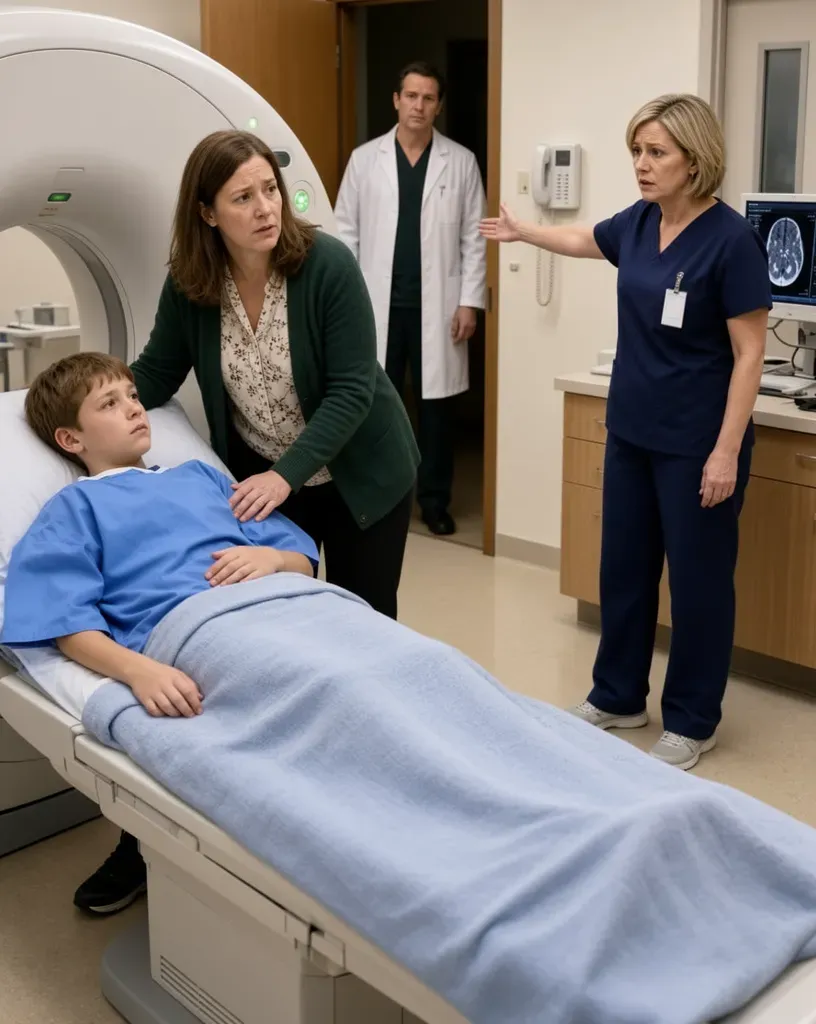
“No one ignores it, doctor,” my husband barked, the edge in his tone sharp, piercing. “He’s just too soft. Kids complain, it’s normal.” My son’s hands were balled into fists, his knuckles white against the hospital gown. The nurse shifted nervously, unsure how to handle the tense exchange.
“Normal?” I retorted, my voice rising, barely able to contain the anger swirling inside me. “Do you think pain is normal? When was the last time you truly listened?” The silence that followed echoed louder than a scream, hanging thick in the air.
My son shifted uncomfortably, the look in his eyes pleading for this façade to shatter. In that moment, I grasped a reality that I had been willfully blind to. “Jake, you’ve been holding this in. Why didn’t you tell me it was this bad? Why didn’t you ask for help?” I asked, my voice barely above a whisper, not wanting to provoke his father’s indignation further.
“I thought…” He paused, swallowing hard before continuing, “I thought you might say I was lying, like Dad.”
The doctor stepped forward, his demeanor calm, creating a small island of reassurance amidst the storm brewing between us. “This is serious, Jake,” he said gently. “You have to trust me when I say that your pain is valid. We’re here to help you.”
A tremor ran through my son’s body. Tears brimming at the edges of his eyelids threatened to spill over, yet he held them back with fierce determination. “I can’t keep hurting and feeling like I’m the problem,” he mumbled, pulling his hoodie over his head and shrinking back into himself.
Shattered Bonds
The doctor’s eyes flickered between my husband and me, gauging our reactions, our willingness to confront the unspoken truths lingering in the air. “What happened wasn’t just an episode of teenage angst. Pain is real, and it manifests in ways we often overlook.”
“Jake can’t be that bad,” my husband chimed in, though his voice wavered slightly, revealing the cracks beneath his bravado. “He needs to toughen up, like we did.” The words landed heavy in the room, and the color drained from my son’s face, despair clinging to him like a second skin.
Would this man ever change? Could he mold himself into the father our son truly needed?
“He doesn’t need to toughen up. He needs to be heard,” I snapped, the fire blazing in my chest now a raging inferno. I felt the walls closing in on us, suffocated by years of miscommunication and negligence.
In that instant, the nurse returned, extracting my son from the tension suffocating him. “Jake, we’ll take good care of you. Just a few more tests and we’ll get to the bottom of this,” she soothed, her presence a soft blanket against the hard reality that seemed to enclose us like a vise.
But my son only nodded, the light in his eyes dimming even further. “Okay,” he mumbled, defeated.
It broke my heart to see him so small, so lost in a world that insisted he had to fight for every ounce of validation. I caught a whisper of an apology dance on my lips, but no words formed.
A Mother’s Resolve
After the nurse whisked him away for more scans, I turned to my husband, desperation filling my veins. “This isn’t just about you or me. We have to do better for him. He’s not seeking attention; he’s begging for help.”
“Help? Or a way to get out of chores?” His response stung sharply, a deflection steeped in denial.
“Those are two entirely different things!” I exclaimed, the frustration bubbling to the surface.
He stepped back, arms raised as if to shield himself from my words. “Fine, then—what do you suggest? We baby him?”
“Maybe it’s time we start treating him like the person he is, instead of the child we think he should be,” I shot back, heat rising in my cheeks. “Stop minimizing his needs, and start hearing his voice.”
With each word I spoke, I felt the shackles of years of complacency cracking under the weight of this moment. This was my son, and for too long, we had overlooked the agony he carried on his shoulders.
When Jake returned, the atmosphere shifted. His eyes were slightly brighter, but the sadness still lingered beneath the surface. I took his hand, squeezing it gently. “You’re strong, Jake. We’re going to get through this together,” I promised, trying to convey all the love I felt in that moment.
The doctor returned shortly after, looking serious but collected. “Jake, we found some inflammation in your spine that we’ll treat, but this is just the beginning. We’re here to help you feel better.”
“Treatment? So… I’m not crazy?” Jake’s voice caught, a hint of hope threading through an otherwise broken landscape.
“Crazy? Never,” the doctor assured him. “What you’re feeling is real, and it matters. We’ll work on this together, one step at a time.”
Jake nodded, allowing himself to lean back against the pillow, the tension slowly ebbing away.
Rebuilding Trust
After we finished in the hospital, the drive back home was steeped in a new understanding. Inside me, fear wrestled with hope; my son might start healing, and maybe, just maybe, his father would learn to see what he’d ignored for so long.
“Jake,” I finally said, my voice gentle. “I’m so sorry for not seeing your pain before. It’s not your fault. You deserve to be heard.”
He looked over at me then, uncertainty mingling with newfound resolve. “I just want you both to listen needed, you know? Like really listen.”
As I parked the car and we stepped inside, the home felt entirely different. It wasn’t just a structure of bricks and walls; it was a place of healing. A sense that, while roadblocks lay ahead, we finally had the tools we needed to navigate them.
“Did you mean it? When you said we would do this together?” Jake asked, hesitation threading through his voice.
“Absolutely,” I replied, pulling him into a fierce embrace.
“Together.”
In that moment, everything seemed possible. Healing wouldn’t happen overnight, but the path forward glimmered like a newfound dawn, calling out to us softly, pulling us toward the promise of a better tomorrow.